Clean Architecture & Dependency Inversion
How LZStock decouples core financial business rules from gRPC delivery and PostgreSQL persistence using strict Go interfaces.
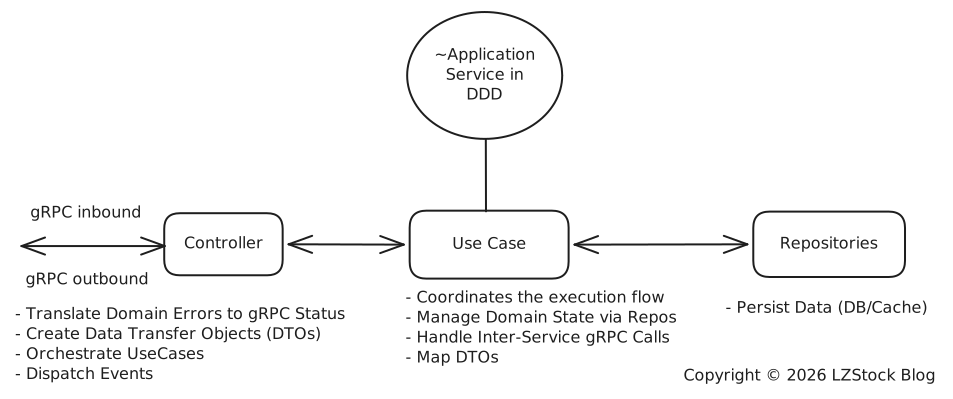
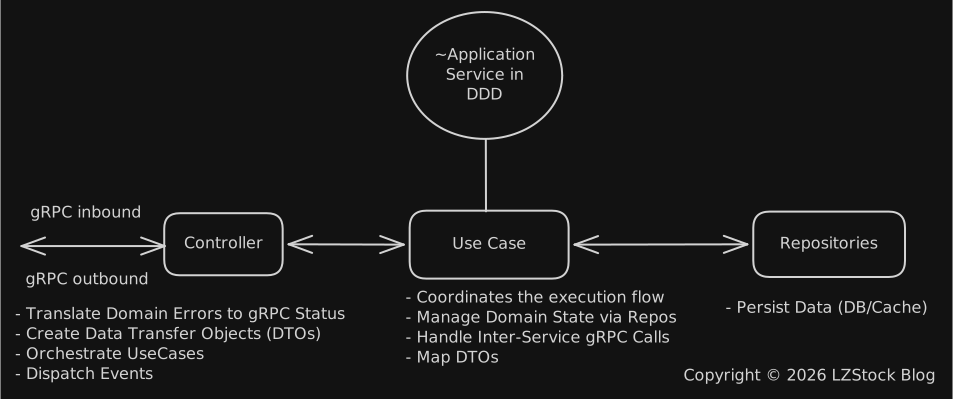
- Strict Domain Isolation: Enforced Clean Architecture principles by isolating the core financial business logic from gRPC delivery and PostgreSQL persistence, treating external frameworks purely as pluggable infrastructure.
- Dependency Inversion via Go Interfaces: Abstracted database operations using repository interfaces, ensuring the UseCase orchestrator never imports concrete SQL/GORM implementations, thus avoiding the "Big Ball of Mud" anti-pattern.
- Embraced the "Mapping Tax": Protected domain models from being polluted by
gormorjsontags by implementing explicit mapping layers (Protobuf ➡️ DTO ➡️ Domain ➡️ DB Schema), guaranteeing absolute framework agnosticism at the cost of acceptable boilerplate.
The Objective
Financial business rules are the most critical—and most stable—asset of this platform. The infrastructure around them (like migrating from REST to gRPC, or swapping PostgreSQL for a NoSQL database) is volatile.
The objective of this architecture is to guarantee 100% isolation of the Core Domain. By strictly enforcing Dependency Inversion, the business logic becomes completely agnostic to external frameworks, eliminating the "Big Ball of Mud" anti-pattern and enabling blazing-fast unit testing via mock injection.
The Mental Model & Codebase Anatomy
In a pure Clean Architecture, dependencies point strictly inward. The Delivery layer (Controller) and the Persistence layer (Repository) are both plugins to the core Domain.
The Data Flow:
Codebase Anatomy:
mods
└── bc1-indicator-insights
    ├── controllers
    │   ├── dashboardCommand.go
    │   ├── dashboardQuery.go
    │   ├── dashboard_test.go
    │   ├── index.go
    │   └── index_test.go
    ├── domain
    │   ├── DashboardAggregate.go
    │   ├── DashboardAggregate_test.go
    │   ├── DashboardID.go
    │   ├── DashboardID_test.go
    │   ├── DashboardName.go
    │   ├── DashboardName_test.go
    │   ├── DashboardStatus.go
    │   ├── DashboardStatus_test.go
    │   ├── DashboardRepository.go
    │   ├── ...
    ├── dtos
    │   └── Dashboard.go
    ├── mapper
    │   └── ToPb.go
    ├── persistence
    │   └── pg
    │       ├── repo
    │       └── schema
    └── useCases
        ├── Dashboard.go
        ├── DashboardRead.go
        ├── DashboardRead_test.go
        ├── Dashboard_test.go
        ├── index.go
        └── index_test.go
Core Implementation
Below is a curated vertical slice demonstrating how Dependency Injection (DI) powers this architecture. Notice the complete absence of concrete database structs in the UseCase.
The Contract (Domain Layer)
// mods/bc1-indicator-insights/domain/repository.go

// The Contract: UseCase depends on this, Repository implements this.
type DashboardRepository interface {
    Save(ctx context.Context, d *Dashboard) error
    FindByID(ctx context.Context, id uuid.UUID) (*Dashboard, error)
}
The Orchestrator (UseCase Layer)
// mods/bc1-indicator-insights/useCases/Dashboard.go

type dashboardUseCase struct {
    repo domain.DashboardRepository
}

// Constructor for Dependency Injection
func NewDashboardUseCase(r domain.DashboardRepository) *dashboardUseCase {
    return &dashboardUseCase{repo: r}
}

func (uc *dashboardUseCase) CreateDashboard(ctx context.Context, dashboardNameStr, investorIDStr, periodTypeStr, toolTemplateStr string) (dashboard *domain.Dashboard, err error) {
    ...
    // 1. Business Logic & Entity Creation

    dashboardName, err := domain.NewDashboardName(dashboardNameStr)
    if err != nil {
      return nil, fmt.Errorf("new dashboardName from %s: %w", dashboardNameStr, err)
    }

    investorID, err := domain.NewInvestorID(investorIDStr)
    if err != nil {
      return nil, fmt.Errorf("new investorID from %s: %w", investorIDStr, err)
    }

    dashboard, err := domain.NewDashboard(dashboardName, investorID)
    if err != nil {
        return fmt.Errorf("domain validation failed: %w", err)
    }
    ...
    // 2. Persist using the abstracted interface
    if err := uc.repo.Save(ctx, dashboard); err != nil {
        return fmt.Errorf("failed to save dashboard: %w", err)
    }
    return dashboard, nil
}
The Plugin (Repository Layer)
// mods/bc1-indicator-insights/pg/dashboard_repo.go

type pgDashboardRepo struct {
    db *gorm.DB
}

// Ensure at compile-time that pgDashboardRepo implements the interface
var _ domain.DashboardRepository = (*pgDashboardRepo)(nil)

func (r *pgDashboardRepo) Save(ctx context.Context, d *domain.Dashboard) error {
    ...
    // 1. Map Domain Entity -> DB Schema Object (Isolation)
    dbSchema := mapper.DomainToSchema(d)
    ...
    // 2. Execute DB Transaction
    tx := r.db.WithContext(ctx).Begin(&sql.TxOptions{
      Isolation: sql.LevelReadCommitted,
      ReadOnly:  false,
    })
    if err != nil {
      return err
    }
    defer tx.Rollback()

    // 1. Save the Aggregate Root
    err = r.saveDashboard(tx, d)
    if err != nil {
      return fmt.Errorf("save dashboard dID %s: %w", d.ID(), err)
    }

    // 2. Save Watchlists (Entities) in the Aggregate
    err = r.saveWatchlists(tx, d.ID(), d.Watchlists())
    if err != nil {
      return fmt.Errorf("save watchlists in dID %s: %w", d.ID(), err)
    }
    ...
    return err
}
Edge Cases & Trade-offs
- The "Mapping Tax" (Boilerplate): The most painful trade-off of Clean Architecture is the constant need to map data across boundaries (gRPC Protobuf ➡️ DTO ➡️ Domain Entity ➡️ GORM Schema). For simple CRUD operations, this feels like massive over-engineering. However, this strict boundary prevents GORM tags (gorm:"primaryKey") or Protobuf JSON tags from polluting the core financial entities, ensuring the domain remains completely framework-agnostic.
- Transaction Management (Unit of Work): Currently, database transactions are managed inside the Repository (tx := r.db.Transaction). This works well for single-aggregate operations. However, if a UseCase needs to orchestrate multiple repositories atomically (e.g., creating a user and their default dashboard), this pattern breaks down. A future evolution would be implementing the Unit of Work (UoW) pattern, allowing the UseCase to control the transaction boundary without coupling itself to *gorm.DB.
The Outcome
By enforcing strict Dependency Inversion, the entire financial domain can be exhaustively unit-tested in milliseconds using generated mock repositories (gomock), achieving high test coverage without ever spinning up a PostgreSQL Docker container.