Blueprint for Technical Deep Dives
The Standard Blueprint for Technical Deep Dives
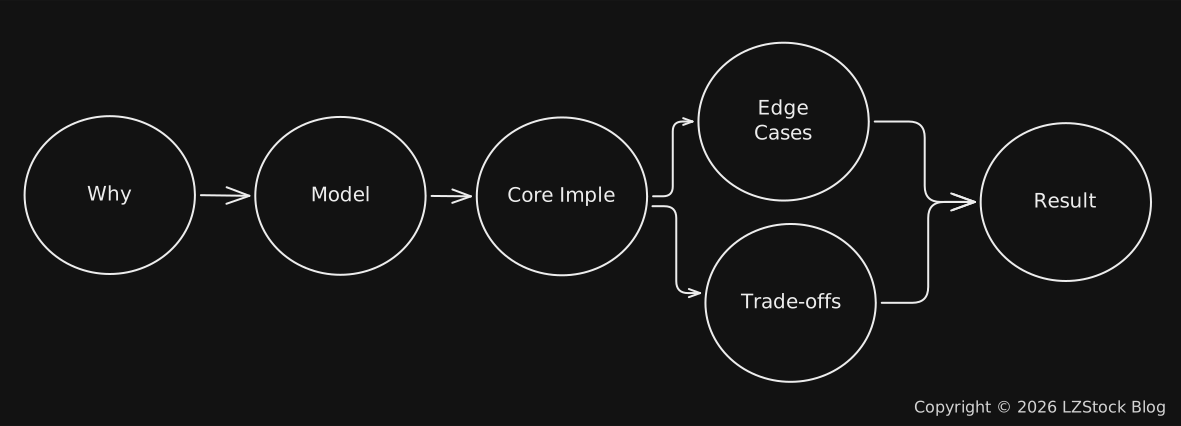
Here is a draft for your introductory Markdown article. It is designed to set clear expectations for your readers, establishing your authority and demonstrating a structured, senior-level approach to technical writing.
When reading technical blogs, time is your most valuable asset. You don't want to sift through thousands of lines of boilerplate code or vague generic explanations just to find the core architectural decisions.
To respect your time and provide the highest signal-to-noise ratio possible, every deep-dive article in this series strictly follows a 5-part standard blueprint. Whether we are discussing high-concurrency streaming engines or complex database indexing, here is exactly what you can expect to see in each section.
1. The Objective (The "Why")
Before looking at how a system is built, we must define why it exists. In this section, you will find the business and technical value of the module. What specific problem does it solve for the product or the infrastructure?
Example: "To decouple the core financial calculation logic from the database layer, allowing for independent scaling."
2. The Mental Model (The Architecture)
Diving straight into code without a map usually leads to confusion. Here, you will find a brief text-based flow, a Mermaid chart, or an ASCII diagram explaining how the data moves or how the execution flows. This provides a high-level conceptual map before we get into the weeds.
3. Core Implementation (The "Meat")
I won't waste your time with fmt.Println, standard error logging, or generic setup boilerplate.
This section focuses entirely on 1 to 2 highly curated code snippets. You will see only the critical interfaces, the core domain structs, or the specific locking mechanisms that make the system tick.
4. Edge Cases & Trade-offs (The Engineering Reality)
Happy paths are easy; real-world engineering is about managing failures and making compromises. This is where we discuss the difficult decisions. What happens if the network drops mid-transaction? Why did I choose a memory-intensive approach (Approach A) over a CPU-intensive one (Approach B)? You will see the exact reasoning behind the architecture's resilience.
5. The Outcome (The Results)
Engineering without measurement is just guessing. Every deep dive concludes with a concise summary tying the implementation back to concrete results, load test metrics, or architectural stability improvements.